

Concerns about the state of the teacher workforce are evergreen. Attracting, developing, and retaining effective teachers in the United States is a long-standing challenge (Kraft & Lyon, 2024), and interest in teaching has dropped precipitously just in the last decade (Bartanen et al., 2025). One common interpretation of this problem is that the job of teaching itself is unsustainable. Teachers are often isolated in an “egg-crate” model, where they work alone in their classrooms with limited opportunities for interaction or collaboration with their peers (Lortie, 1975). Teachers are often asked to do too much, work in isolation, receive inadequate preparation and support, and rarely have opportunities to advance in their career without leaving the classroom. To address teacher workforce issues, then, we may need to redesign the job itself.
In response to these persistent challenges and lagging student outcomes, efforts to “reimagine teaching” and redeploy the workforce have taken off nationwide. Often called “strategic school staffing,” these efforts challenge the traditional “one teacher, one classroom” model with approaches to more strategically deploy a diverse workforce. In brief, strategic staffing is a framework for rethinking how schools organize educators’ roles, time, and pay to better align with teacher expertise and student needs. This might entail expert teachers extending their reach or taking on mentorship roles, assembling teams of educators with complementary expertise to share responsibility for a larger roster of students, or allowing for more career growth and differentiation opportunities than is typical for the profession. The field is broad, encompassing multiple approaches, but is built on evidence-based tenets such as collaboration, distributed leadership, and differentiation. Many schools already employ some of these aspects sporadically, such as utilizing collaborative structures like Professional Learning Communities or deploying paraprofessionals for pull-out interventions. However, truly “strategic” staffing goes beyond periodic coordination or the delegation of supplementary tasks; it requires formal, structural shifts in the core instructional model and a reorganized approach to educator roles.
Figure 1: K-12 Student Enrollment in California, 2017-18 to 2024-25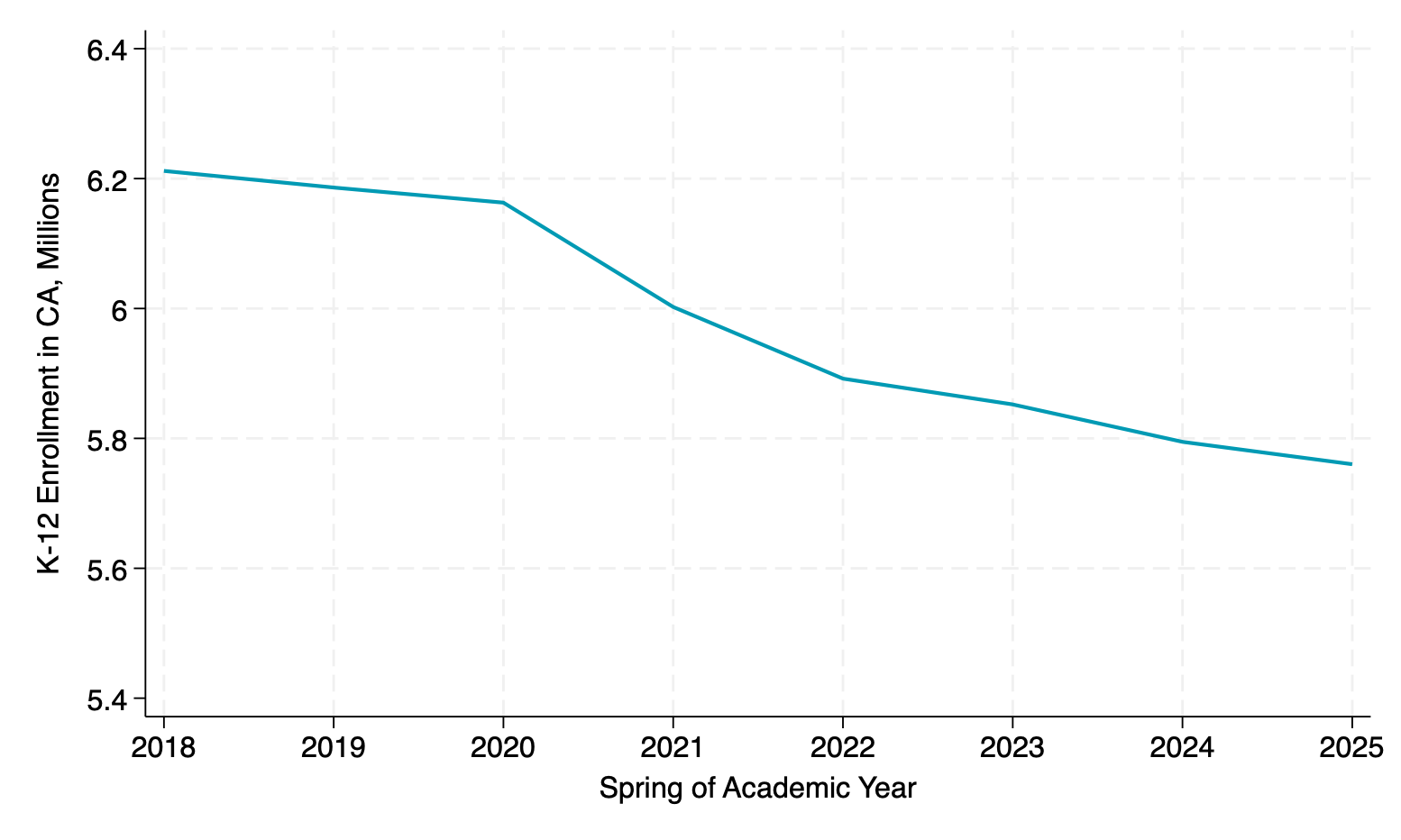
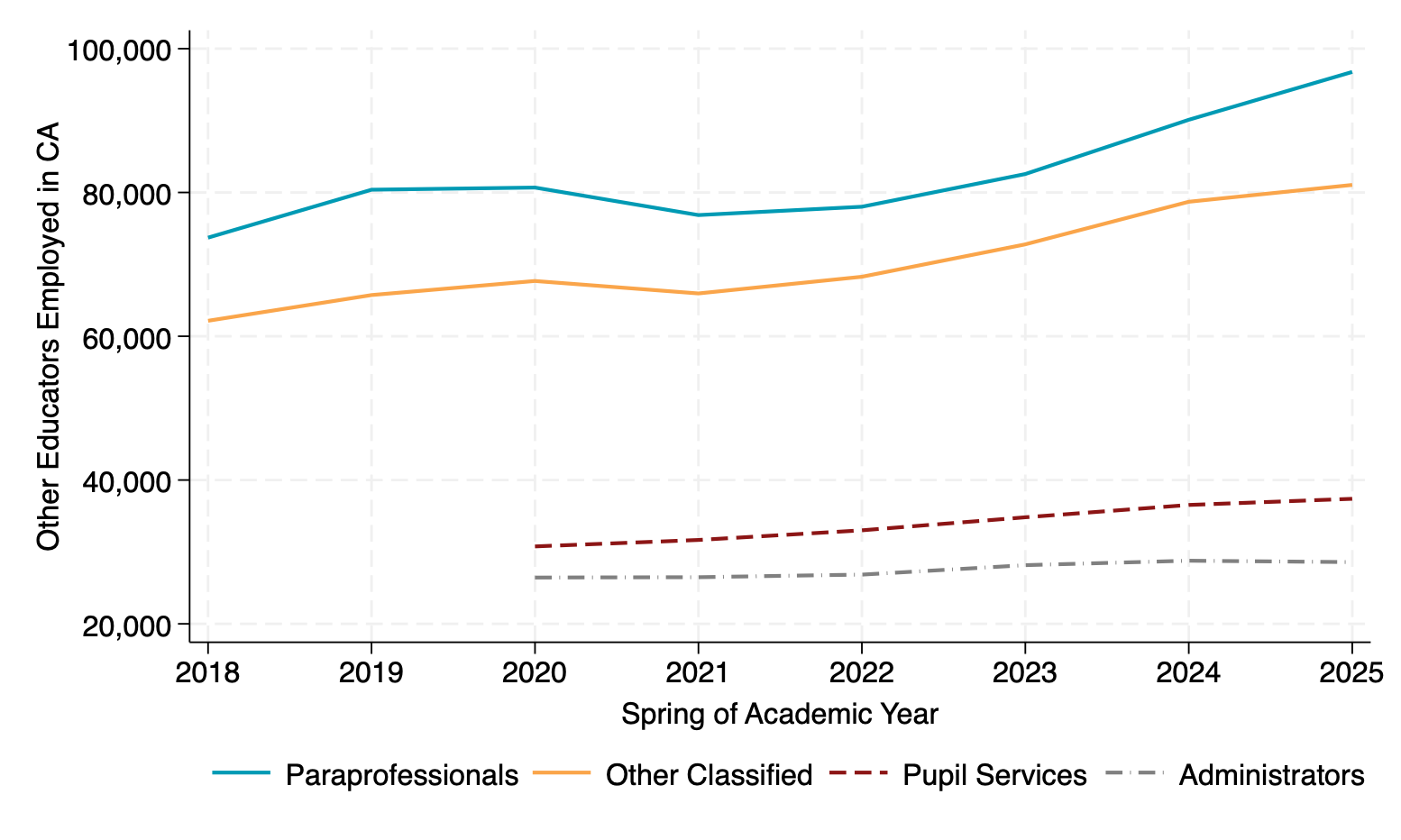
Efforts towards more strategic staffing also align with a rapidly changing educator workforce. Staffing numbers in schools have consistently grown over the last decade, even while enrollments fall. These nationwide trends are also prevalent in California schools, as demonstrated in Figures 1 and 2. Since 2017-18, California K-12 enrollment has dropped from over 6.2 million to just under 5.8 million in 2024-25, a drop of about 7% (Figure 1). The number of traditionally certified teachers, on the other hand, has grown modestly, from about 282,000 in 2019-20 to 286,000 in 2024-25, an increase of about 1.4% (Figure 2A). But classrooms often include valuable staff members that are not the official teacher of record: paraprofessionals, instructional aides, teaching assistants, and so on. This workforce is rapidly expanding in the U.S. (Bisht et al., 2021), and California is no exception. California schools employed nearly 100,000 paraprofessionals in 2024-25, a whopping 30% increase from the roughly 74,000 employed in 2017-18 (Figure 2B). Certificated pupil services and other classified staff also saw large rises over the same time period, while administrators saw more modest increases of 8% since 2019-20. In brief, the last several years have seen a steady increase in the number of adults employed by California schools, even as student enrollment declines. This divergence reinforces the need to strategically deploy the existing workforce, reallocating existing human capital and resources to better serve students.
While interest in alternative staffing is expanding nationwide, empirical evidence regarding implementation and scalability is still emerging. School-level practitioners and district leaders frequently question whether these departures from traditional staffing are worth the investment and can sustainably support instructional staff and improve student outcomes. At the same time, policymakers need a clear understanding of the return on investment and the specific conditions necessary for high-fidelity implementation. Despite the promise these models hold for addressing California’s workforce challenges, there is a critical need to assess how they interact with the state's specific policy landscape.
This report addresses this gap by investigating the viability of strategic staffing in California through four primary research questions:
- What is the existing evidence on strategic school staffing?
- What is the current state of school staffing in California, and how might we consider re-deploying the current slate of staff members in schools more effectively?
- What is the level of interest and “appetite” for alternative staffing models among California school leaders?
- What systemic barriers limit the adoption and expansion of strategic staffing in California?
To answer these questions, we conduct a broad literature review of both "name-brand" models (e.g., Next Education Workforce, Opportunity Culture, TAP) and their underlying tenets, such as teaming and differentiation. We pair this review with qualitative insights from semi-structured interviews with nearly eighty principals in schools throughout California.
Figure 2: Educators Employed in California Schools, 2017-18 to 2024-25
We present a growing body of evidence that strategic staffing models work for both teachers and students. The research is clear that the individual tenets of strategic staffing models—collaboration, differentiated roles, and differentiated compensation—are associated with improvements in both teacher and student outcomes, and that “name-brand” models that combine these different tenets are also building a consistent evidence base of positive effects. We also find that, despite a strong appetite for flexibility and the demonstrated impact of these models, California principals rarely feel they have the professional discretion they need to enact more innovative staffing approaches. Interviews confirm that many schools in California already are pursuing flexible staffing models, but they are often forced to innovate despite current policies rather than because of state support. We identify several key barriers—based on both existing policies and principals’ perceived obstacles—and conclude with policy implications and suggestions to foster a more supportive policy environment for reimagining the teaching role.