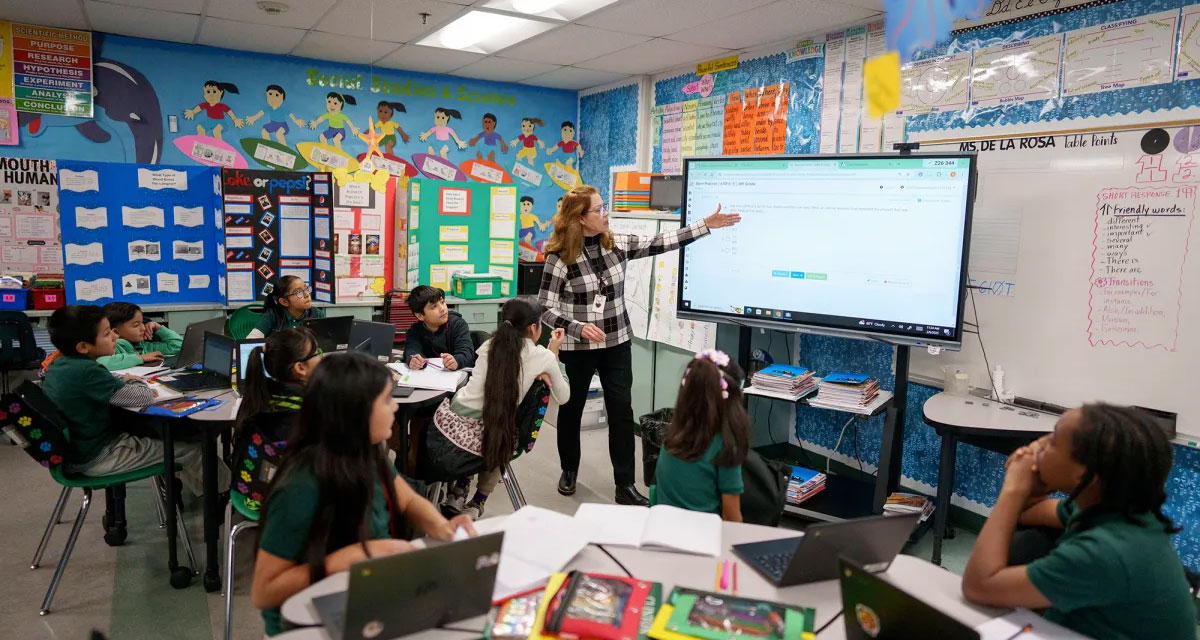


Paraeducators, non-certified school employees who work under the direct supervision of credentialed teachers or administrators (Every Student Succeeds Act [ESSA], 2015; McDermott et al., 2024), devote substantial time to providing instructional and behavioral support for students with disabilities. Their responsibilities are remarkably diverse. Various reports document their involvement in activities ranging from one-on-one academic support, communication and social skill instruction, and community-based instruction to assisting with students’ personal care and fulfilling clerical duties (Bernal & Aragon, 2004; Carter et al., 2009). Critically, these paraeducators work closely with students—with 97% reporting providing one-on-one instruction to students multiple times per week (Carter, O'Rourke, Sisco, & Pelsue, 2009). In many schools, paraeducators have become the front-line providers of instruction and behavior support for many students with the most intensive needs.
Schools across the United States are increasingly relying on non-certified educators to support students’ learning and behavioral needs. From 1990 to 2018, the number of teachers in US schools increased by 7.8% (i.e., from 2.4 millions to 3.2 million); whereas the number of paraeducators (including those who provide in general education and special education settings) increased by 108.5% during the same time period (i.e., from 395,960 to 825,630). This trend is also reflected in the number of paraeducators in U.S. schools who provide services to students with disabilities through special education services. Recent data indicate that in the 2021-2022 school year over 540,000 Full Time Equivalent (FTE) paraeducators were employed across Parts B and C of IDEA, a figure that has grown by 23.2% over the past decade (U.S. Department of Education, 2024). In fact, most schools employ more special education paraeducators than special educators (Giangreco, Hurley, & Suter, 2009), with a ratio of approximately 1.1 paraeducators for every one special education teacher (U.S. Department of Education, 2024). Schools' use of paraeducators continues to increase due to standards-based reforms, changing service delivery models, and economic pressures (Giangreco & Broer, 2007; Walker & Smith, 2015). Given their sheer numbers and the critical nature of their roles, paraeducators represent an indispensable component of the special education service delivery model.
Despite their growing prevalence and importance, the paraeducator workforce faces significant challenges related to a pervasive lack of training and support. It is problematic that paraeducators receive such limited initial or in-service training on basic instructional practices (Breton, 2010), particularly when they are often essential providers of instruction. The fact that most have never received in-service training on the basic instructional strategies they are expected to implement means they are unlikely to possess the knowledge and skill necessary to effectively meet the needs of the students they serve (Brock & Carter, 2015; Giangreco, Edelman, Broer, & Doyle, 2001).
Unfortunately, federal law provides little specific guidance on the training and supervision of paraeducators (Mason et al., 2021). As a result, training efforts have been described as informal, individualized, idiosyncratic, and haphazard. When training is provided, it frequently consists of one-time workshops without the necessary follow-up, monitoring, or performance feedback needed to build and sustain instructional skill (Bernal & Aragon, 2004; Walker et al., 2017). This issue is compounded by the fact that the special education teachers who are tasked with supervising paraeducators often report feeling underprepared for this role (Biggs et al., 2019; Breton, 2010). The situation is problematic; as Brock and Carter (2013) noted, “asking paras to work with students absent adequate training and support is unethical and unfair to both students and the paras” (p. 212).
This lack of professional support, coupled with low salaries and ill-defined roles, predictably contributes to challenges with job retention (Carter et al., 2009; Fisher & Pleasants, 2012). Previous reports examining state-level data have indicated annual attrition rates for paraeducators as high as 28%-40%--rates frequently higher than that of special education teachers (Gilmour, Aniagyei-Cobbold, & Theobald; 2026). Further, Kaler and Theobald (2026) demonstrated that, in the state of Washington, paraeducators who were men or individuals of color were more likely to exit the workforce compared to their female and white colleagues. The resulting cycle of recruiting, hiring, and onboarding new staff consumes district resources that could otherwise be invested in more substantive training initiatives (Billingsley & Bettini, 2019). This creates a problematic system where schools must rely on their most under-supported personnel to provide instruction to their most vulnerable students, a practice that directly challenges the ability of schools to deliver a free and appropriate public education (Suter & Giangreco, 2009).
Fortunately, a growing body of evidence demonstrates that, with the proper support, paraeducators can learn and effectively implement evidence-based strategies to improve student outcomes (Carter, Cushing, Clark, & Kennedy, 2005; Causton-Theoharis & Malmgren, 2005). The critical question is not if paraeducators can be effective, but how schools can best prepare and support them. Research indicates that to be effective, paraeducators require explicit training in evidence-based practices (EBP), a clearly defined supplemental role, and ongoing monitoring and supervision from a trained educator (Brock & Carter, 2013; Suter & Giangreco, 2009). This training must move beyond one-time workshops to incorporate key components such as modeling, role-play, and repeated performance feedback (Brock & Anderson, 2021).