
Francesca López, Alfredo J. Artiles, Paul Bruno, Dion Burns, Desiree Carver-Thomas, Linda Darling-Hammond, Kramer Dykeman, Alexandria Hurtt, Jacob Jackson, Havisha Khurana, Tara Kini, Michal Kurlaender, Beryl Larson, Melanie Leung-Gagné, Susan K. Patrick, Heather Price, Sherrie Reed, Lucrecia Santibañez, Christopher Saldaña, Carolyn Sattin-Bajaj, Lucy Sorensen, Joao M. Souto-Maior, Tiffany S. Tan, Ilana Umansky
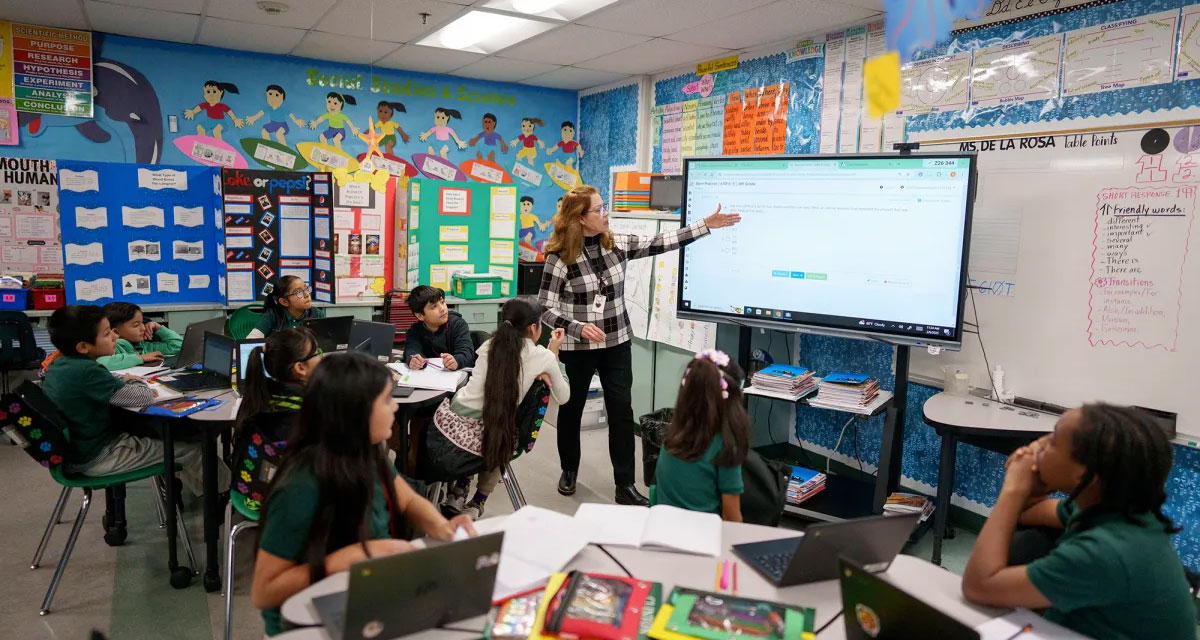
California is home to one of the largest populations of multilingual learners of English (MLEs) in the nation. Roughly one in three students in the state’s K–12 system has ever been classified as an English learner, and more than two million children speak a language other than English at home. As one of the defining features of California’s educational landscape, this population represents one of the most important tests of the state’s public education system.
Over the past two decades, California has pursued ambitious efforts to improve outcomes for MLEs. Significant policy reforms spanning teacher training requirements, funding structures, transitional kindergarten, and accountability systems have been enacted with that goal in mind. A synthesis of longitudinal research documents genuine progress: successive cohorts of kindergarten MLEs have shown improvements in English language acquisition and third-grade performance on state assessments in both English language arts and mathematics. The achievement gap between students who have ever been classified as EL and those never classified as EL has narrowed (Novicoff et al., 2024). These are meaningful gains, and they reflect real investment.
The students who have benefited most from California’s recent reforms tend to be those whose trajectories most closely resemble the modal MLE: entering school as a kindergartner, making steady progress toward reclassification, and eventually achieving English proficiency within a few years. The picture is considerably more complicated for students who acquire English more slowly, those with disabilities, and those concentrated in schools with fewer qualified teachers.
This brief draws on five recent research reports to examine where California’s progress has been strongest and where critical gaps remain. These reports tell a consistent story: California has built a serious, reform-minded system for supporting MLEs, but that system has not yet been designed with sufficient specificity to reach the students who need it most. The sections that follow describe what the research shows and what it suggests about where California’s policy attention might most productively go.
Key Findings
1. Progress is real and concentrated among students whose trajectories most closely match the typical MLE pathway. California’s policy investments have improved outcomes for many MLEs, with earlier reclassification and stronger third-grade performance across successive kindergarten cohorts. Positive outlier districts demonstrate that better outcomes are achievable within the existing system. But reclassification by the end of elementary school has changed little, the achievement gap between students who have ever been classified as EL and students never classified as EL has not closed, and a growing gap has emerged between when students attain English proficiency and when they are formally reclassified.
2. Long-term English learners represent a structural, not incidental, challenge. Approximately one in three English learners remains classified for seven or more years, the majority of whom entered California schools in kindergarten. Students with disabilities who are also classified as MLEs face compounded disadvantages: by grade 12, one-third of these dually identified students have become long-term English Learners, compared to 12 percent of MLEs without disabilities, and their high school completion and college enrollment rates lag substantially behind all comparison groups.
3. Reclassification criteria are producing uneven, and potentially counterproductive, results. California is unique among states in requiring four distinct criteria for reclassification. The academic criterion varies so substantially across districts that a student’s likelihood of remaining classified as an English learner after achieving actual English proficiency depends more on where they attend school than on their language development. At the secondary level and in rural districts, this criterion is more likely than the English proficiency standard to be the binding constraint.
4. Teacher preparation has improved, but structural inequities in teacher quality persist. The 2021 reforms to MLE credential preparation represent a meaningful return to a more specialized model. However, schools serving the highest proportions of MLEs, especially LTELs, continue to have systematically less qualified teaching staff. Districts and teachers also appear to lack adequate instructional materials for supporting multilingual learners, with fewer than one quarter of teachers reporting that their ELA materials are adequate for helping multilingual learners master standards. A geographic mismatch between where bilingual preparation programs are located and where bilingual teachers are needed remains unresolved, with high-need regions along the southern border and in the Central Valley most affected.
5. Other states provide relevant examples of alternative policy approaches. Texas and Indiana outperform California on fourth-grade NAEP reading for MLEs, a gap that has persisted since the late 1990s. Both states treat MLE instruction as a specialized professional domain with distinct certification pathways and externally verified competency requirements. Both also use more targeted funding mechanisms, including proficiency-differentiated weights and formula-based incentives for dual language programs that California has not yet tried.